
|
Issued in ET Pools
$54.5B
|
Issued in Last 18 Months
$36.2B
|
Issued Since May
$10.3B
|
Issuance Has Accelerated
There has been an explosion in GNMA extended term (ET) pool issuance in recent months. Of the $54.5B ever issued in ET pools, $36.2B has been issued in the last 18 months, and $10.3B since May!
The modified loans underlying ET pools are typically at the final stage of the FHA and VA loss mitigation waterfall. Borrowers often end up in these pools due to multiple failed prior modifications and loss mitigations.
The credit quality deterioration in post-pandemic vintage GNMA loans – and their implications for MSR investors – are a topic we have discussed in numerous publications and webinars. As we have shown, the deterioration is a combination of worsening attributes (e.g., the % of loans with DTIs>50), weak HPA in recent vintages, and other factors that are not directly tied to observables.
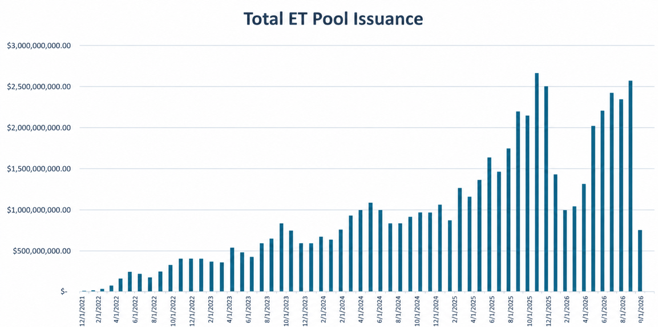
And for these and other reasons, we believe ET issuance will continue unabated and even increase.
Recent ET Pools Show Extraordinary Delinquency
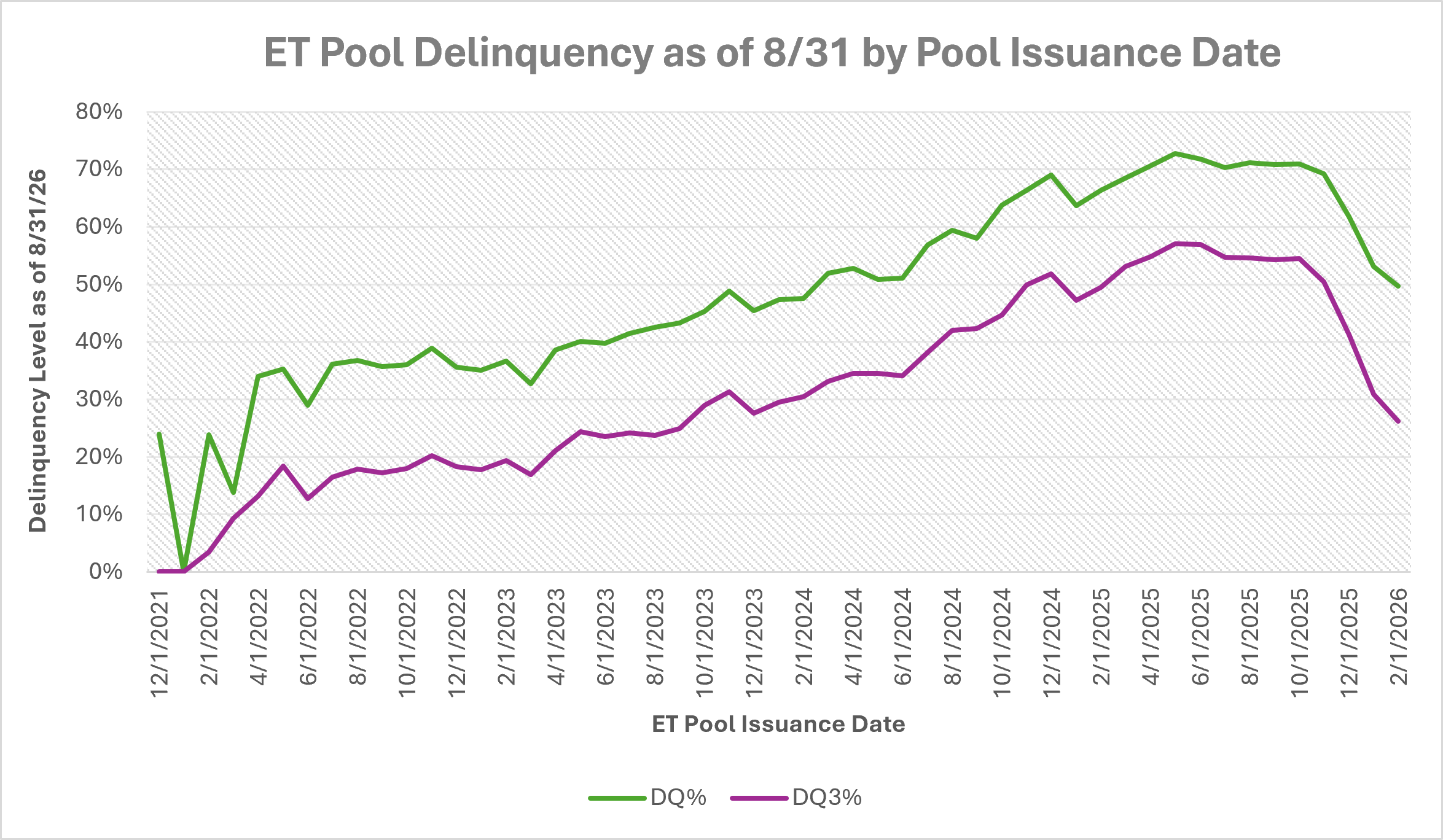
Despite the lower payment resulting from the term extension and other features of the modification (e.g., partial claims), the credit performance of ET pools has been exceptionally poor as shown above.
|
Overall Delinquency
30–40%
|
2024 Q4 – 2025 Q4
60–70%
Total delinquency
|
2024 Q4 – 2025 Q4
40–50%
D90+ rates
|
Overall delinquency levels hover around 30-40%. However, the 2024 Q4 – 2025 Q4 pools have 60-70% total delinquency and 40-50% D90+ rates.
VA Loans Make Up More of Recent Issuance
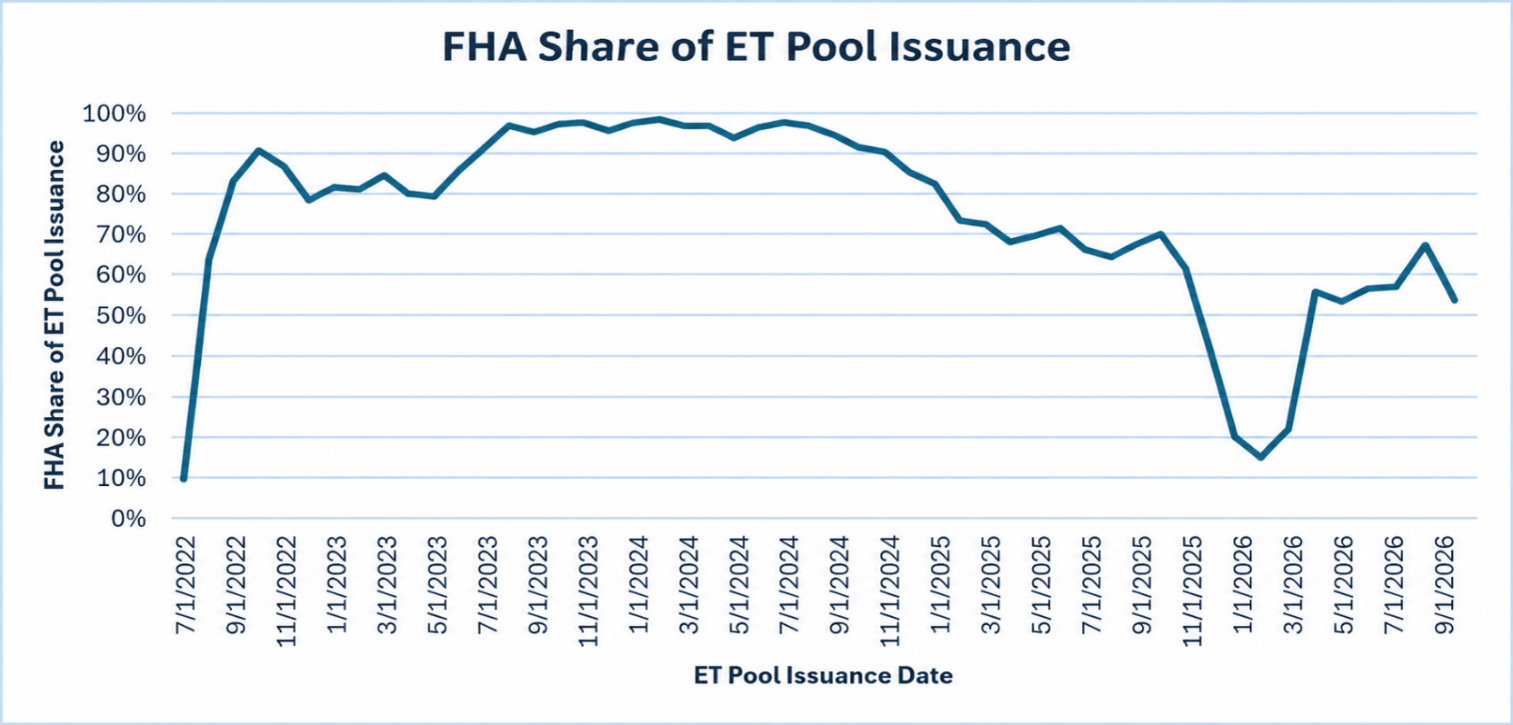
The composition of ET pools has also changed dramatically over the past few years. While most pools from 2022-2024 were entirely comprised of FHA loans, the newer issuances have a 70% or below share.
Increases in VA credit risk are rarely discussed, but the relative increase in credit risk compared to pre-pandemic levels is actually higher in VA than in FHA. This explains the increasing VA presence in ET issuance.
Our CORE™ model has long recognized the complexity of GNMA credit (and prepay) modeling. We have fully segmented models for the FHA, VA, RHS, and PIH sub-sectors.
And within these segmented sub-sectors, we separate Modified and Streamlined loans from Purchase/Refinance.
Implications
This credit deterioration has disparate implications for mortgage investors.
|
For GNMA MBS investors, this credit performance results in high termination rates (either through buyout or re-modification or default resolution) which can be attractive to fixed income investors looking for opportunities in the short duration space.
Obviously, lower coupon GNMA investors benefit from higher ET buyout/default rates.
|
However, the implications for GNMA MSR investors are not so simple. While slower prepays benefit the MSR owner, higher credit risk means higher expenses and higher advancing costs
|