
The Recapture Discussion Has Changed
Recapture has been part of MSR economics for a long time. Buyers consider it when they price servicing, sellers see the impact in actual bids, and servicers spend considerable time and money trying to retain borrowers as loans pay off.
The accounting treatment has not always been as clear. Existing guidance has left room for different interpretations about whether the value of recapture belongs in the measurement of the existing MSR.
What FASB Has Proposed
In March, the Emerging Issues Task Force (EITF) recommended that FASB address whether value attributable to recapture should be included when measuring an MSR under ASC 860-50. The EITF noted that the existing guidance did not clearly address the issue and had resulted in diversity in practice.
On May 27, FASB added the issue to its technical agenda and tentatively agreed that:
The Board also selected a modified prospective transition approach and directed its staff to draft a proposed Accounting Standards Update for a 45-day comment period.
For MSR holders, valuation firms and auditors, the development is significant. The discussion is moving toward how recapture should be recognized and measured under GAAP.
What We See in the Market
Fair value is intended to reflect the price that would be received in an orderly transaction between market participants. In the MSR market, buyers routinely consider recapture when deciding what they are willing to pay.
MIAC has consistently seen those economics reflected in actual transactions, particularly in higher-WAC portfolios where borrowers have a greater likelihood of refinancing.
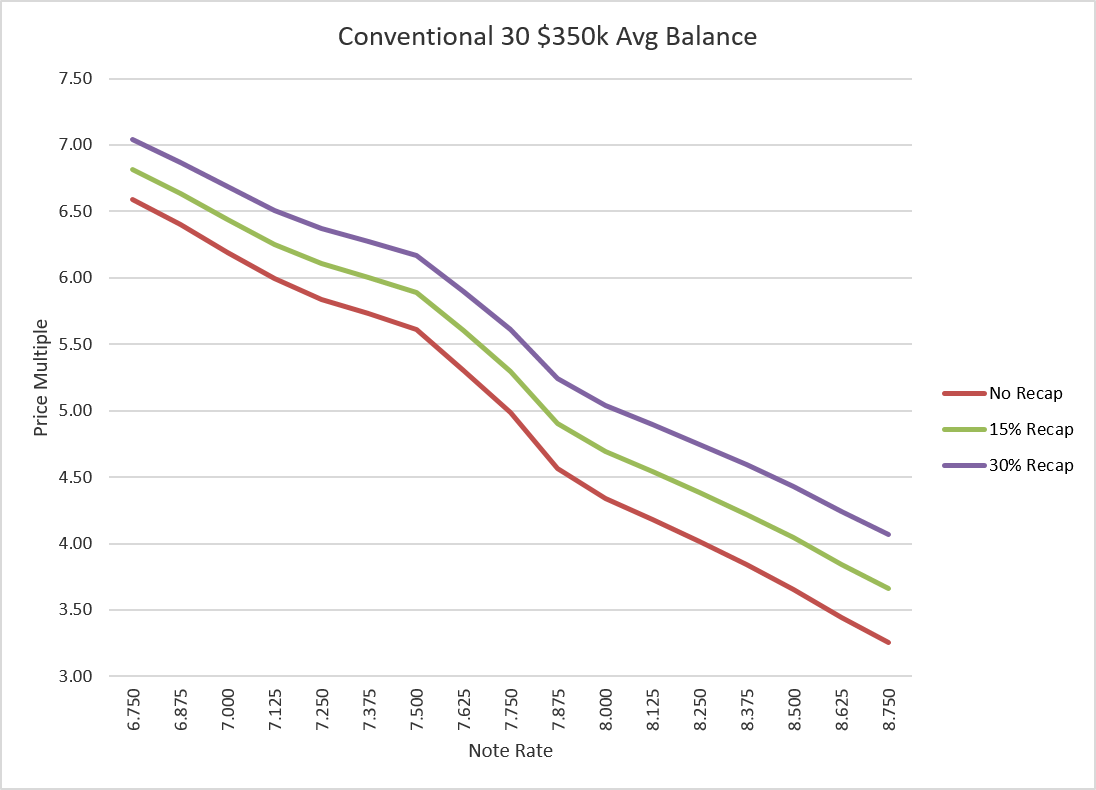
Our original analysis compared 0%, 15% and 30% recapture assumptions across different borrower note rates. Higher recapture assumptions produced higher MSR multiples, with a more pronounced impact at higher borrower note rates.
Why We Model Recapture Directly
There are other ways to make an MSR model arrive at the market price. You can reduce voluntary prepayment speeds, adjust the discount rate or use scalars that compensate for recapture without explicitly identifying it.
MIAC’s approach is to model recapture directly and tie it to voluntary prepayment behavior. That makes the assumption easier to explain, test against actual transactions and review with auditors.
The Opportunity Changes With Borrower Behavior
|
↓
When projected voluntary prepayments decline, there are fewer borrowers to recapture.
|
↑
When voluntary prepayments increase, the opportunity grows.
|
Recapture does not have the same value in every interest-rate environment.
Borrower note rate matters as well. A borrower with a 3.50% mortgage in a 7% mortgage-rate environment presents a very different opportunity than a borrower with a 7.50% mortgage. Cash-out activity and other borrowing needs can still create opportunities within lower-rate populations, but the economics are different.
The assumption also needs to reflect market participants. One servicer might have an exceptional recapture platform, while another has very little capability. Those differences affect their own economics, but they do not automatically change the fair value of otherwise identical MSRs.
A company’s actual performance is useful information. For fair value, though, the question is what market participants would pay for the recapture opportunity associated with the portfolio.
Why the Additional Work Has Been Part of the Debate
One argument against including recapture has been that the servicer must contact the borrower, originate a new loan and successfully retain the customer. The resulting cash flows require additional work and are not contractually guaranteed.
That distinction has always been difficult to apply to MSRs because servicing itself requires ongoing work. Servicers collect payments, manage escrow accounts, assist delinquent borrowers, process payoffs and handle customer service.
MSR valuations already consider servicing costs, float, late fees and other ancillary income associated with that operation. From MIAC’s perspective, the borrower relationship also creates a recapture opportunity that buyers consider when pricing the asset.
Where Does This Go From Here?
FASB still has to complete its standard-setting process, and implementation, modeling and audit support will remain important parts of the discussion.
FASB’s recent actions move the accounting discussion closer to what we have observed in MSR transactions for years.